Patented Mobile Observatory · US 11,306,864

A big telescope under dark skies — without lifting a thing.
Welcome to the adventure — aboard our Mobile Observatory!

A true mobile observatory for heavy astro gear. Your telescope rides fully assembled on a patented suspension platform, tows behind your SUV or truck, and deploys under dark skies — single-handedly. Parked at home, it's your permanent backyard observatory. Our functional prototype proves the concept and the damping technology today — and Version 2, the model we'll build for customers, is in design and fabrication right now.

  HOW IT WORKS — THE 58-SECOND CONVERSION FILM
150 kg
Payload — 16" scopes, EQ or Alt-Az, fully mounted
~15 min
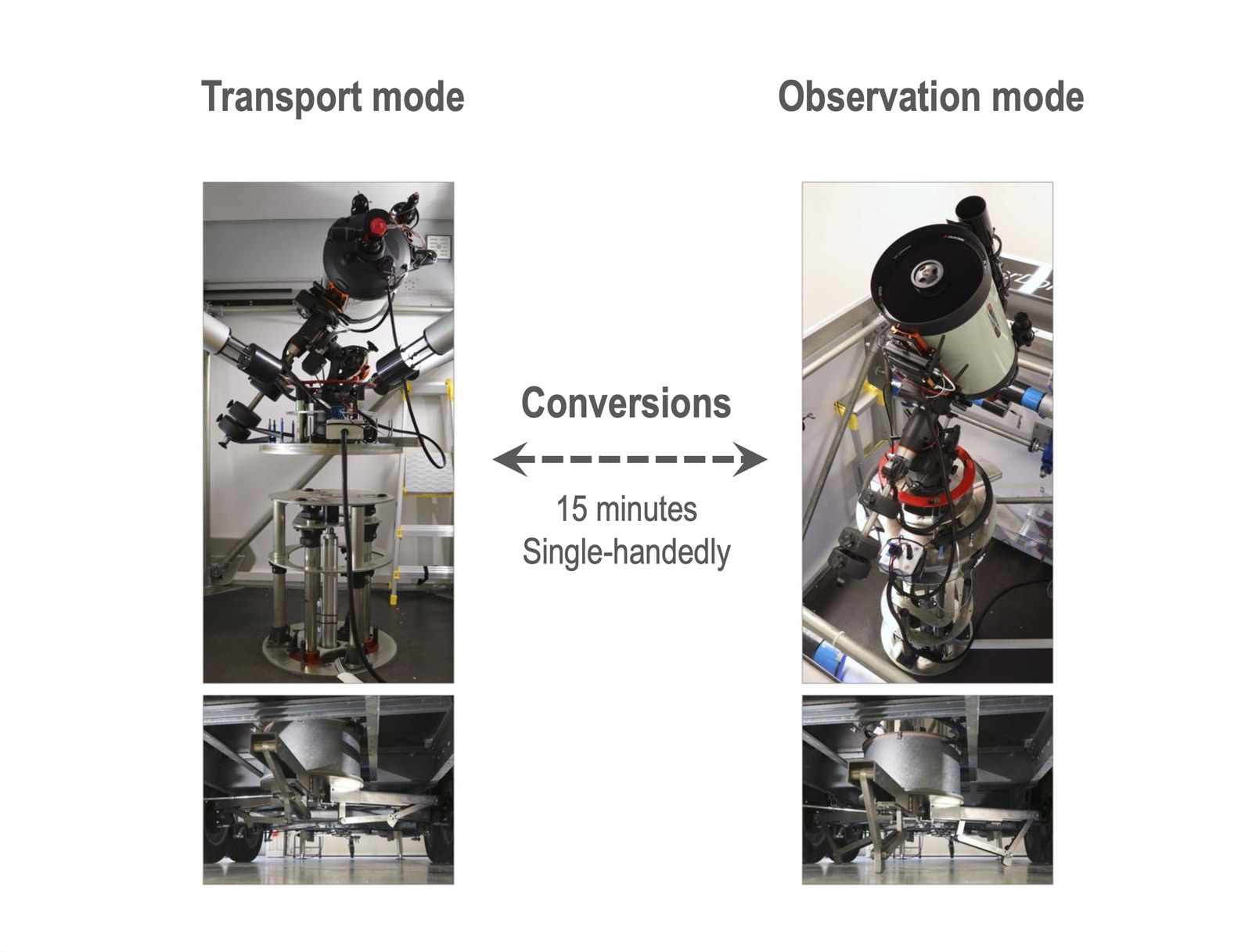
Transport mode to observation mode, single-handedly
10,000 km
Proven on the platform — 150+ conversion cycles
3 modes
Transport · Stationary · Observation — one machine
One Machine · Three Modes

A home observatory that happens to have a hitch — um, and also wheels!

Most nights it sits sealed in your yard like a permanent roll-off observatory. But when the forecast turns ideal, it becomes the reason you're imaging under Bortle 2 skies by ten o'clock. Dare we say it's the ultimate "grab 'n go" telescope — except you're going mobile with a big scope and a whole lot of comforts. It's the best of both worlds: the backyard observatory you've always wanted, and the dark-sky adventures you never want to give up — hot cocoa, fresh air, and all the splendor of the heavens. Craving the adventure of astronomy? So are we!

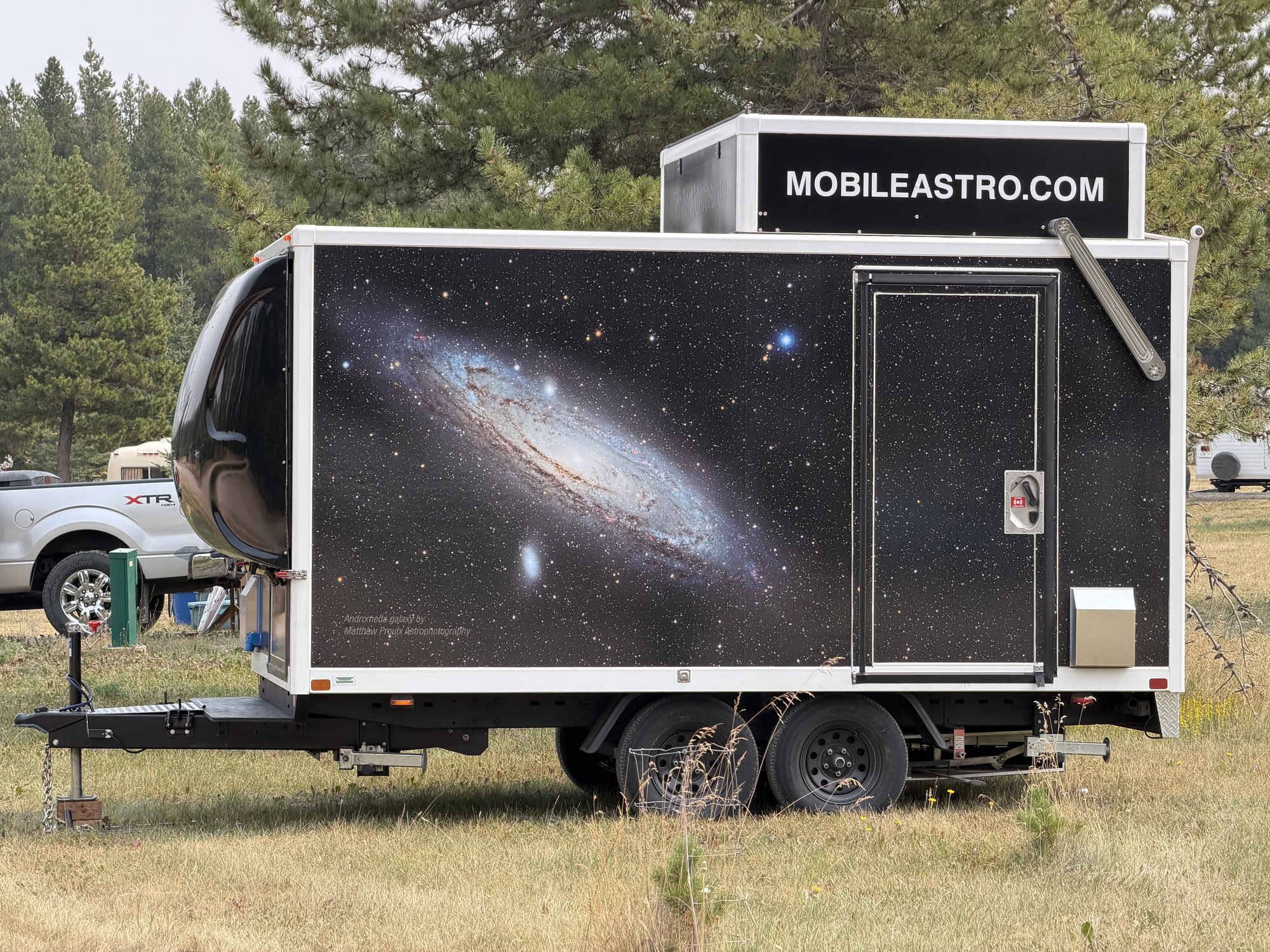
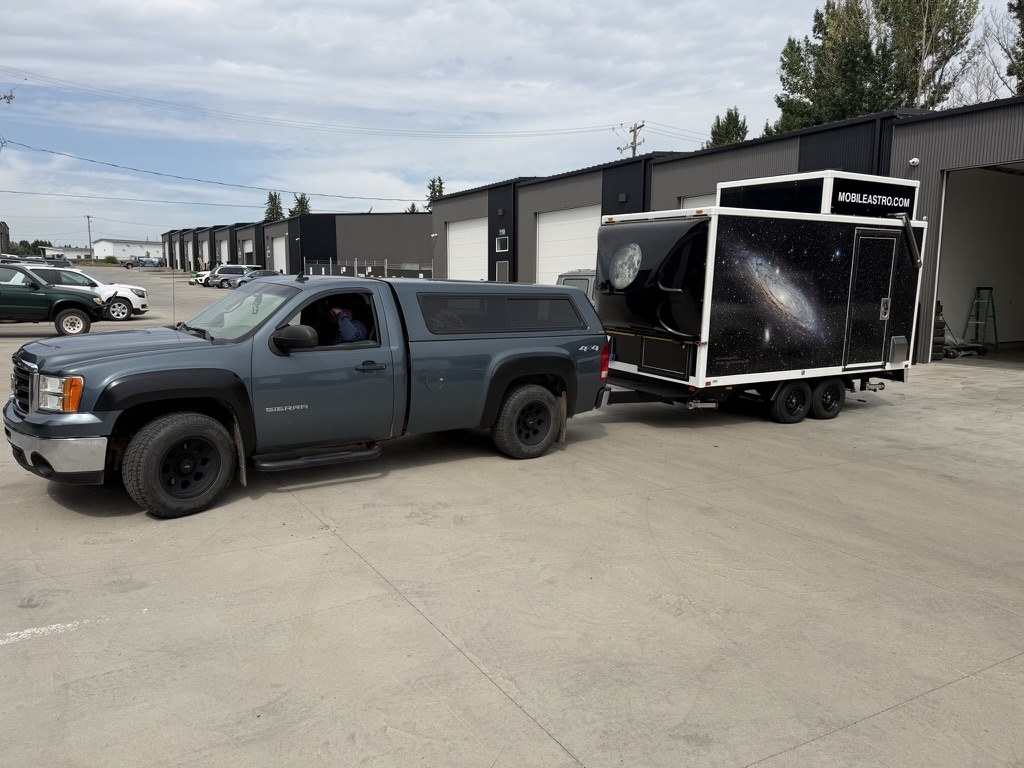
The decaled Mobile Astro trailer hitched to a GMC Sierra pickup, wind deflector open showing the Moon graphic
The Mobile Astro trailer parked and sealed among pine trees, roof closed
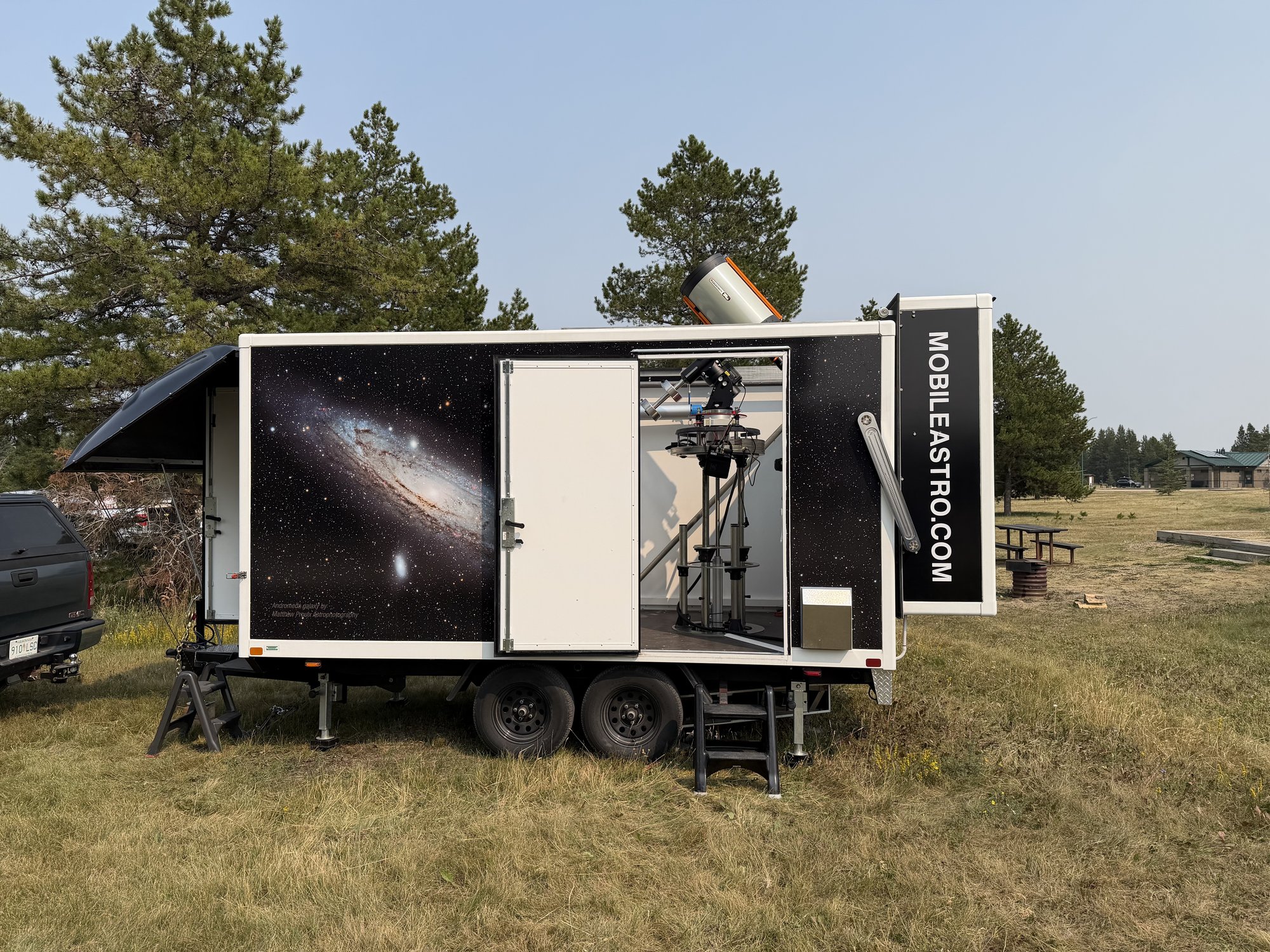
The trailer deployed in observation mode — roof tilted back, telescope raised above the roofline
Stationary

Parked and sealed — roof closed, pier well capped, cabin sealed against dust, mice, and insects. It serves exactly like a traditional backyard observatory dome, ready to open in minutes.

NO CONCRETE PADNO BUILDING PERMIT*ALWAYS RIGGED

"I'm selling my big rig — I can't do the heavy lifting anymore."
We built this so you never have to say that.

No assembling in a frozen field. No 70-pound lifts to the saddle in the dark. Your scope stays mounted, collimated, balanced, and cabled — permanently. You just drive, deploy, and image.

Field Procedure

Driveway to first photons, in four moves.

The entire conversion is motorized and single-handed — proven over 150+ full cycles. No heavy lifting whatsoever. Nothing is unloaded and nothing is assembled: the observatory is the trailer, and the conversion is built into the machine itself.

01 · TOW

Hitch and drive

Tows behind a capable SUV or pickup. Your gear rides fully mounted on a 280 kg suspension platform — the smoothest-moving object on the entire equipage, including the towing car.

GRAVEL-ROAD PROVEN
02 · ANCHOR

Ground the rig

The self-leveling tripod extends to the ground beneath the chassis and drop-locks on contact — pure gravity and mechanics.

440 KG GROUND WEIGHT
03 · RELEASE

Detach from trailer

The rig mechanically decouples from the chassis entirely. Footsteps, wind on the cabin, a slammed door — none of it reaches your mount.

FULLY ISOLATED
04 · OBSERVE

Open and image

Roof tilts back behind the rear wall; gear lifts for a free horizon, full 360°. Polar alignment is preserved between sessions in stationary mode.

T→S 10–12 MIN · S→O 2–3 MIN
Watch The Machine Work
THE FREE-FLOATING SUSPENSION — YOUR GEAR RIDES ISOLATED FROM EVERY BUMP
SELF-LEVELING TRIPOD DROPS TO THE GROUND BENEATH THE CHASSIS
RELEASED & ANCHORED — 440 KG STANDING FREE OF THE TRAILER
MOTORIZED CONVERSION — EVERY STEP DRILL-DRIVABLE AS BACKUP
The Patented Core

One solution for two conflicting demands.

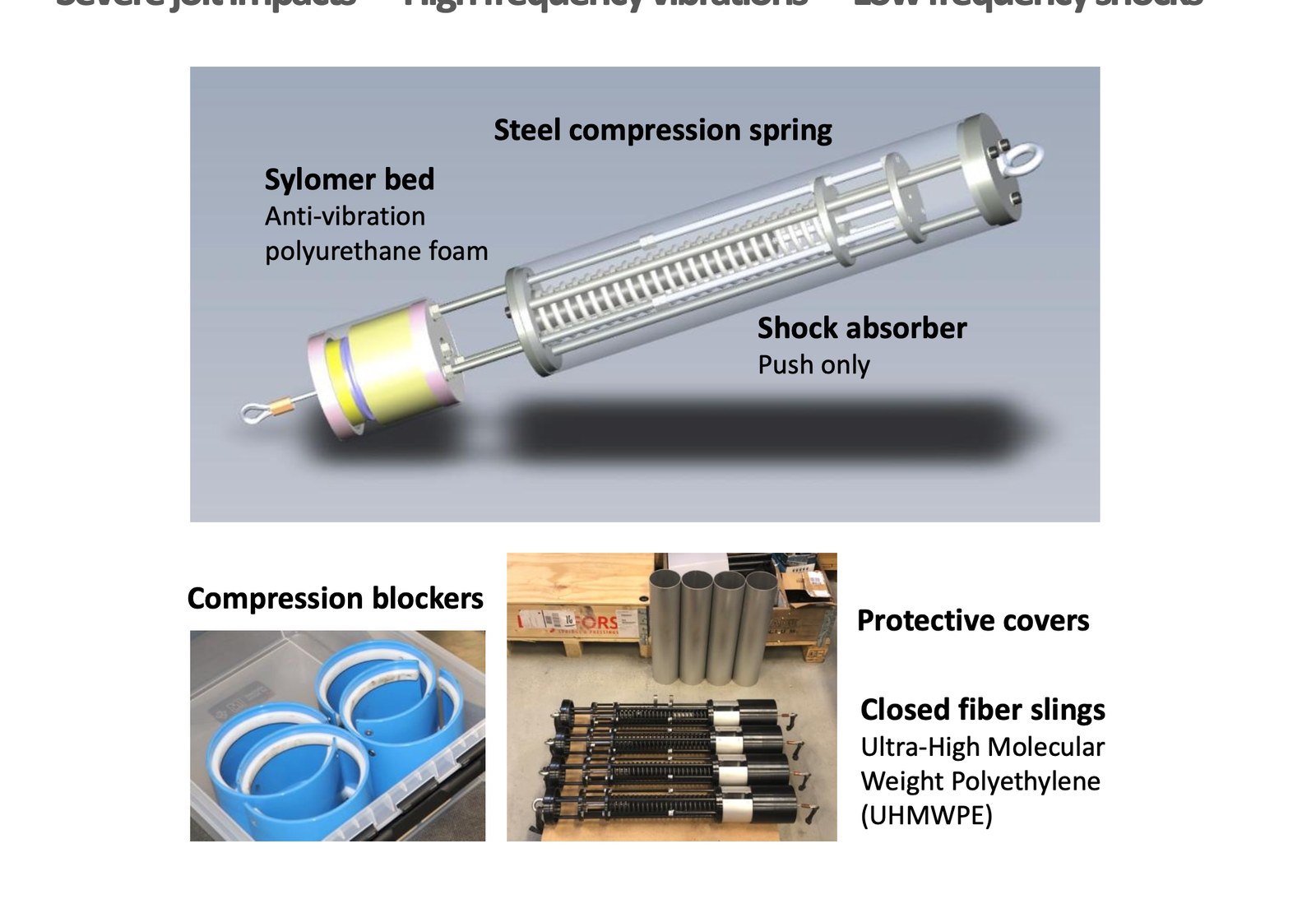
In transport, your gear must be held as loosely as possible. The mounted rig hangs on a suspended platform inside the frame, isolated by patented damping trains that absorb high-frequency vibration, low-frequency shocks, and severe jolts — independently. Swiss MSR accelerometer analysis confirmed the platform rides smoother than the towing car itself, and panic-braking tests at 80 km/h left the pier standing upright.

In observation, it must be rock-solid. The same machine anchors your rig to the ground at 440 kg, mechanically decoupled from the trailer. Sidewalk-quality stability, anywhere you can park.

"Astrophotography is hard. We're working to make the heavy lifting and the setup easy."

— DESIGN PHILOSOPHY: MECHANICS OVER ELECTRONICS, EVERY CRITICAL SYSTEM DRILL-OPERABLE. (THIS WAS THE PHILOSOPHY OF THE PROTOTYPE UNIT — WE MAY HAVE A NEW AND IMPROVED PHILOSOPHY WITH VERSION 2.) ITERATION, EVOLUTION, OPTIMIZATION.

Every safety-critical function works without software: drop-locking legs actuated by the pier's own weight, conversions drivable by a handheld drill if power fails. The electronics add convenience; the physics guarantee function.

The prototype is an excellent test bed for our research and development at Mobile Astro Corp. We aim to make Version 2 with many added attributes in terms of features and performance — benefits you will appreciate:

  • Lighter weight
  • Higher towing speed
  • Optimization of the "astro gear" rig capacity
  • Deployment electrics and motor controls with sensor feedback in all steps and stages — including safeguards to enforce correct deployment in the field; the control panel will guide the procedure steps in order with sensor verification
  • Automatic anti-icing door seals and weather awareness

Platform Specifications

PROTOTYPE vs V2
SPECPROTOTYPE · PROVENVERSION 2 · IN DESIGN
Payload capacity150 kg · 16" scopes · EQ / Alt-AzTarget 200 kg · 20" class
Gear envelope1100 × 1100 × 1100 mmOptimized — in design
Overall (L×W×H)550 × 205 × 330 cmUnder 9 ft tall — in design
Gross weight2,500 kg incl. gearTarget 2,000 kg
Towing speed80 km/h110 km/h
Suspension platform280 kg, free-floatingPatented damping, evolved
Observation ground weight440 kg, anchoredAnchored — spec TBD
DeploymentElectric / manualAuto assist · digital checklist failsafe · manual override
Power4 kWh · 12/24 VDC · 110/220 pure sineLiFePO4 · solar option
CabinsHeated control room + observatoryHeated · anti-icing seals
SecurityTriple alarm + cloud cameraEnhanced · all-sky weather watch
VerificationMSR damping assessment · road approvedTest program to come
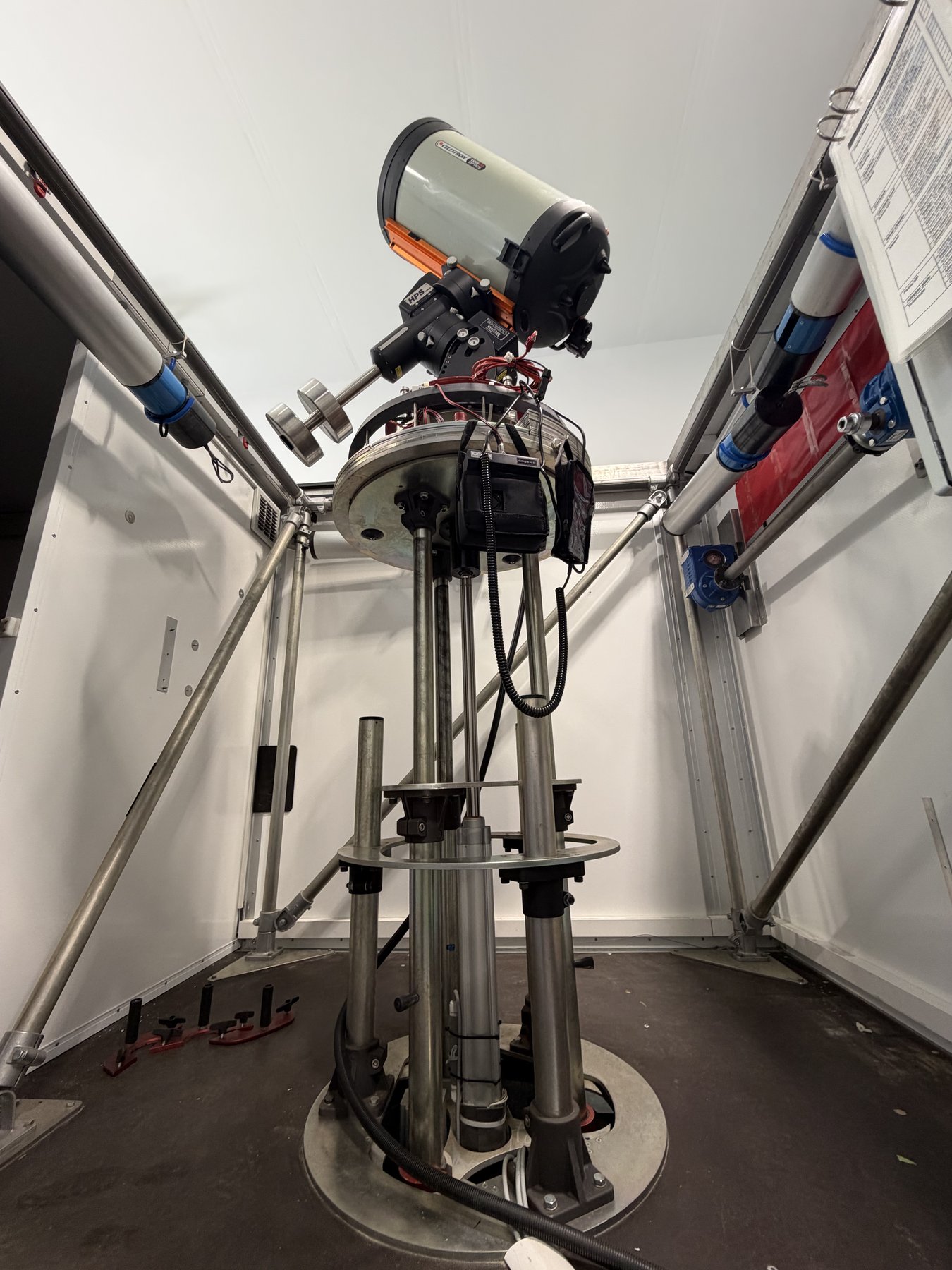
The full telescopic pier inside the observatory cabin, floor-anchored with the mounted telescope above
THE PIER — ANCHORED TO THE GROUND, FULLY DECOUPLED FROM THE TRAILER
From the Engineering File
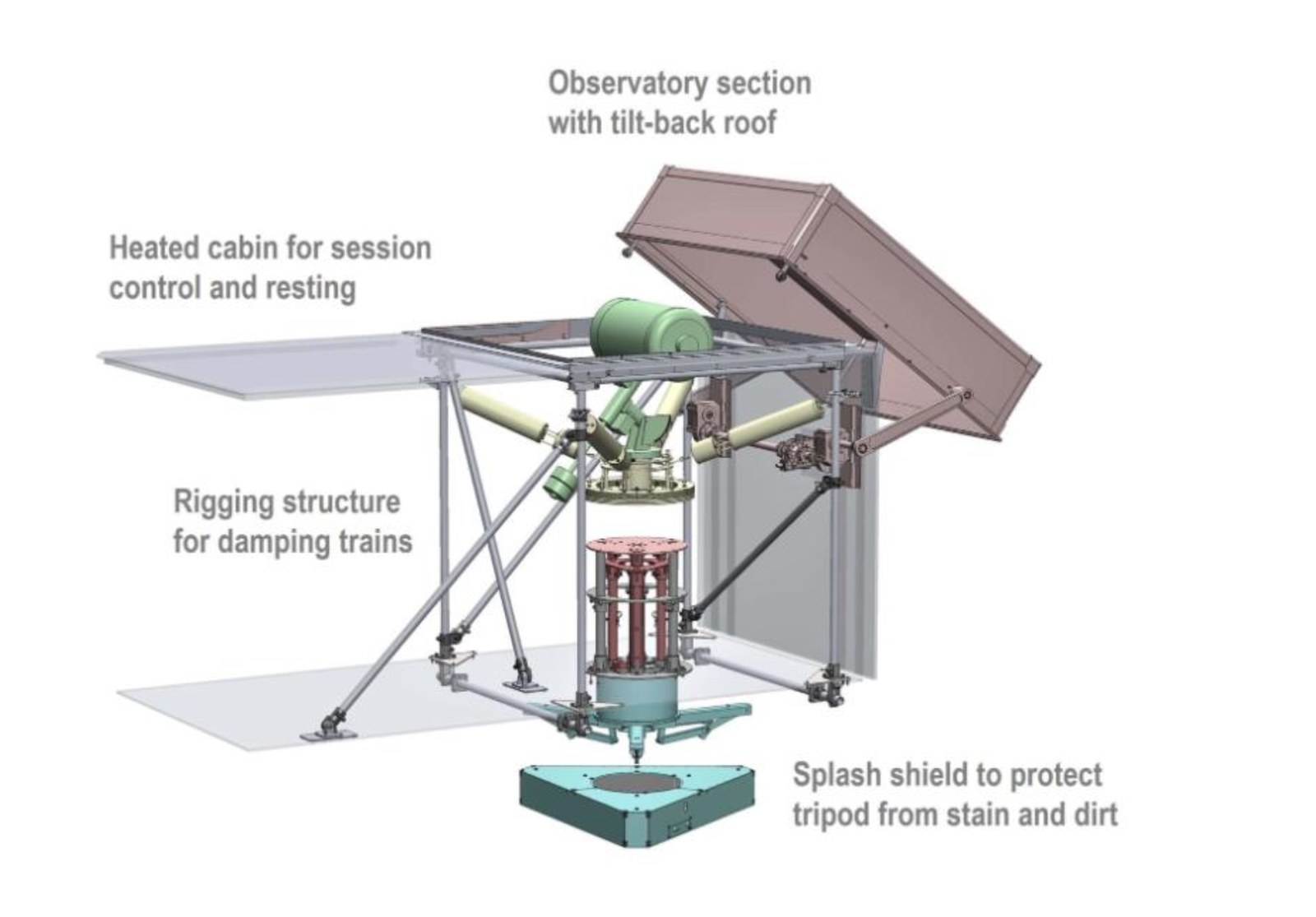
Exploded CAD view of the full system: tilt-back roof, rigging structure for damping trains, pier, and splash shield
THE FULL SYSTEM — TILT-BACK ROOF, DAMPING RIGGING, PIER & SPLASH SHIELD
Cutaway of one damping train: Sylomer anti-vibration bed, steel compression spring, push-only shock absorber, with compression blockers, protective covers, and UHMWPE fiber slings
ONE DAMPING TRAIN — SYLOMER BED · STEEL SPRING · SHOCK ABSORBER · UHMWPE SLINGS
Side-by-side comparison of the rig in transport mode and observation mode, converting in 15 minutes single-handedly
THE RIG CONVERTS — TRANSPORT ↔ OBSERVATION · 15 MINUTES · SINGLE-HANDEDLY
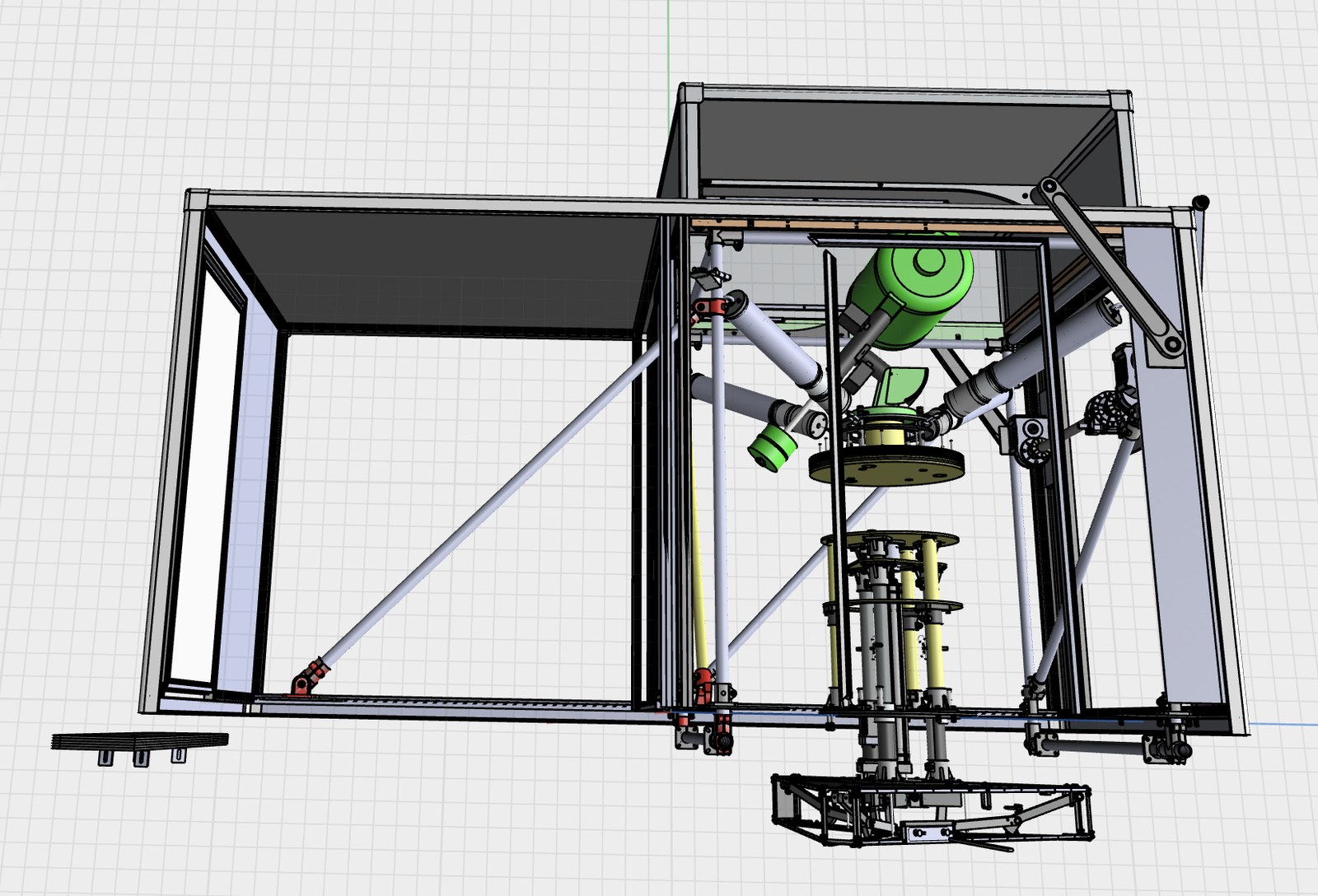
Version 2 of the mobile observatory being designed in 3D CAD — frame, damping trains, pier, and tripod modeled
VERSION 2 — IN DESIGN RIGHT NOW, MODELED IN 3D CAD
Questions, Answered

Everything people ask us.

What is a mobile observatory?+
A trailer built around one job: carrying your larger telescope fully mounted, balanced, and collimated to remote sites, then anchoring it to the ground as solidly as a permanent pier. It's not a cargo trailer you set up equipment from — the observatory is the trailer. Nothing is assembled or dismantled in the field, ever. We have our prototype mobile observatory, and our "Version 2" would be fabricated for sales to customers.
Why not just build a backyard observatory?+
A fixed dome commits you to whatever sky sits above your house — forever. Parked at home in stationary mode, Mobile Astro is your backyard observatory: sealed, secure, always rigged. But when the sky forecast is clear, it also tows to dark skies. You get both, without pouring concrete or pulling a building permit.
Why do dark skies matter so much?+
Light pollution buries faint signal. Narrowband filters help from the suburbs, but they only work for emission targets and cost you hours of integration. Under a Bortle 1–3 sky, broadband targets — galaxies, reflection nebulae, dust — become reachable, and every hour of exposure counts for several city hours. Dark sky is the single biggest upgrade in astrophotography, bigger than any camera.
Who is it for?+
Serious astrophotographers running heavy gear; astronomy clubs and universities doing outreach; and especially anyone who's been told by their back pain to downsize. Many of our conversations start with "I can't do the heavy lifting anymore." Our answer: don't downsize — stop lifting.
Is the technology patented?+
Yes — US Patent 11,306,864 covers the core solutions: the suspended damping platform, the self-adjustable drop-locking pier, and the transport/observation decoupling method. Licensing inquiries from organizations are welcome through the order page.
How big a telescope can it carry?+
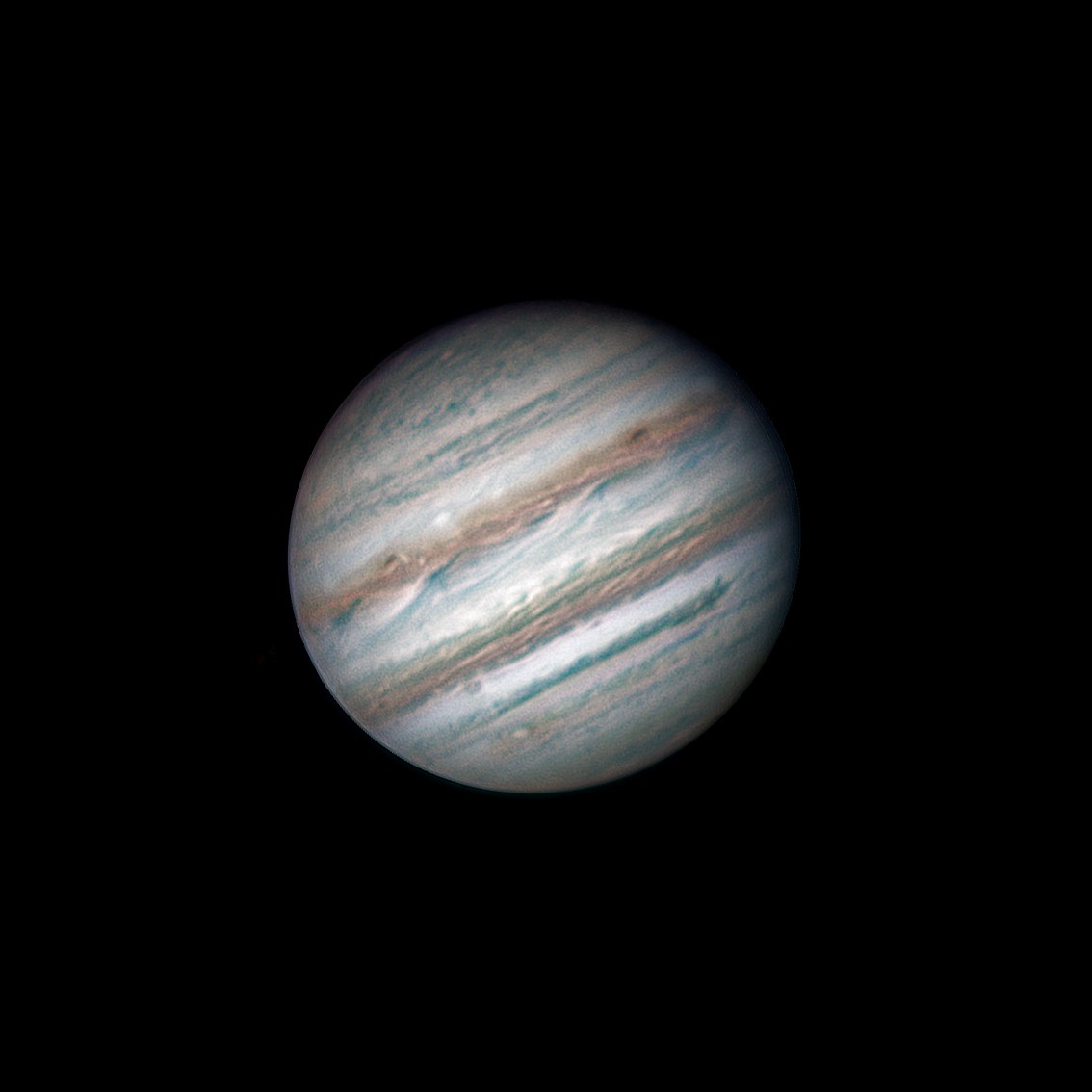
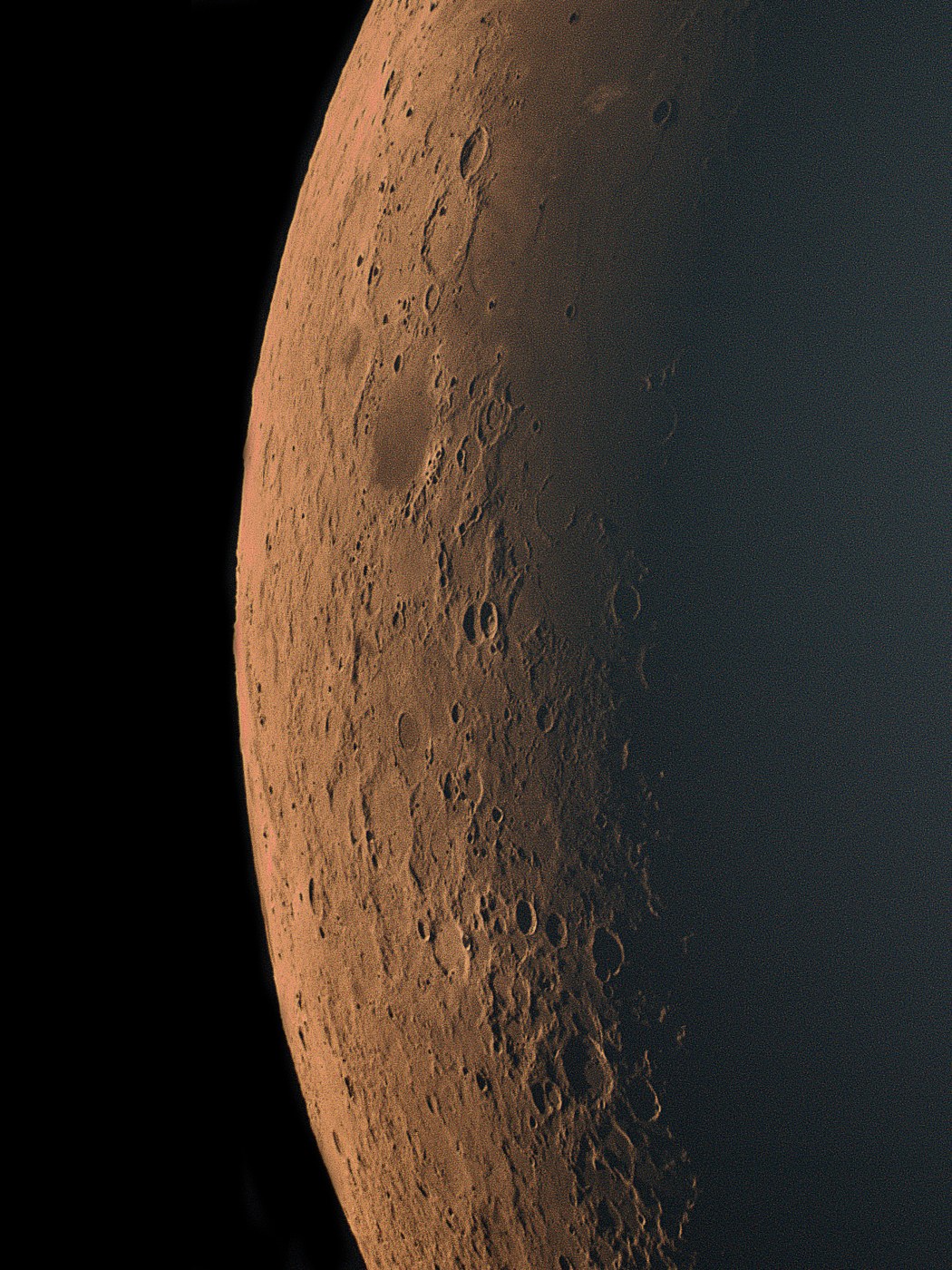
Up to 150 kg of mounted gear, 16-inch class optics, on equatorial or Alt-Az mounts, within an envelope of 1100 × 1100 × 1100 mm. The proven prototype currently carries a Celestron C14 Edge HD on a 10Micron GM2000. It has been mainly used for planetary astrophotography; a fairly large Newtonian can be carried, and we are considering various options. Common brands and models fit within the limits.
Will my telescope survive gravel roads? Will it need re-collimation?+
This is the patented core of the machine. Your gear rides on a 280 kg free-floating platform isolated by damping trains that absorb vibrations, shocks, and jolts independently. Swiss MSR accelerometer analysis showed the platform moving more smoothly than the towing car itself. Across 10,000 km and 150+ conversion cycles — highways and gravel alike — the prototype's optics have held collimation with zero damage.
Is polar alignment preserved?+
In stationary mode, yes — the top rig's position is mechanically fixed, so your alignment survives between sessions at the same site. After transport to a new location, you'll do a normal polar alignment; the mount adapter provides full 360° rotation and ±3° leveling to make it quick.
What happens in a panic stop?+
Tested, on purpose: full panic-braking runs at 80 km/h on dry asphalt. The damping trains take the jolt and the pier stays upright. Peak forces on the dampers reach about 3,250 N — well within their designed envelope.
What vehicle do I need to tow it?+
Gross weight is roughly 2,500 kg including your gear — within range of most half-ton pickups and many mid-size SUVs with a proper towing package. A compact crossover won't cut it. We'll confirm your specific vehicle's rating during the order consultation. Version 2 will have a lower gross weight.
How long does deployment take? Can I do it in the dark?+
Transport to stationary takes 15 minutes; stationary to full observation another few minutes typically. All of it is single-handed, motorized, no heavy lifting — and yes, it can be done in the dark if you have to. Version 2 may deploy even faster, but really the main thing will be to make it easier to deploy.
How fast can I close up if weather rolls in?+
The observation-to-stationary transition is the fast one — lower the gear, close the tilt-back roof: 2–3 minutes and your optics are sealed away from rain. Version 2 will have more automation for this, with an all-sky camera and weather alerts that you can choose to configure as you wish.
What if the power system fails in the field?+
Every powered conversion function can be driven by an ordinary handheld drill, and the critical anchoring mechanics run on gravity alone. You will never be stranded with a scope you can't stow. This is true for the prototype, and Version 2 will have even more protection and failure proofing.
Can it sit on my property most of the time?+
That's the intended life for it. In stationary mode the cabin is fully sealed — dust, insects, and mice stay out — and it functions exactly like a permanent home observatory dome. You'll have the best of both worlds — capable of imaging from your backyard but also ready to get out to your favorite dark skies locations! Because it's a registered trailer rather than a structure, it typically avoids the permits a built observatory requires (HOA rules vary; being towable is usually what saves you).
What about cold weather?+
The best imaging season is winter, so it's built for it: a heated control-and-resting cabin sits beside the observatory section with an inside door between them. You manage your session warm while the optics stay at ambient. Battery and power systems are specified for cold climates — this machine is engineered in Norway, Sweden, and Saskatchewan, where we take winter personally. Dome and door seals have a frost heater strip incorporated, as will Version 2.
How is it secured?+
Triple alarm system including interior motion detection with a cloud camera, lockable doors and hitch, and the sealed stationary mode. Your insurance company will want the details; we'll provide full documentation.
How long does the battery last off-grid?+
The 4 kWh pack delivers 12/24 VDC and pure-sine 110/220 VAC — comfortably multiple full imaging nights for a typical rig with dew control. Solar charging is available as an option for extended stays. Electric generators can also be used.
Can I run it remotely?+
Session control from the heated cabin is standard. Full remote operation (including remote polar alignment workflows and connectivity options such as satellite internet) is part of the V2 option sheet — tell us your intended use in the order inquiry and we'll spec it with you.
How much does it cost?+
The unit we are showing on our Mobile Astro Corp website is a functional prototype unit. We are now in the process of design and fabrication of "Version 2" or "V2" as we call it. Ballpark best guess? That's what I would want to know as a customer, and we believe it will have to be somewhere around $100,000 – $200,000 USD. Sometimes when you do not easily see the price of something, you already know it is going to be "expensive" or "over priced". We get that feeling — we understand that feeling. We are not yet ready to advertise the actual price of our V2 model — but this will come eventually. Right now we want to show you what we are developing. I suppose we will be wanting to gauge the amount of interest from all of the various customers out there. We are endeavoring to produce a high quality mobile observatory that will serve you for years to come! Pricing depends on configuration and options, and V2 build pricing can be finalized with each accepted reservation. Submit an order inquiry and we'll send the current price sheet and delivery timeline. For reference: you're comparing against a permanent observatory build plus the dark-sky property to put it on.
Where is it built? Do you ship globally?+
The Version 2 platform is engineered and assembled in Saskatoon, Saskatchewan, Canada — and possibly also assembled in Scottsdale, Arizona, USA. Built for North American roads, regulations, and winters. Export inquiries are welcome — freight and compliance are quoted per destination.
What warranty and service?+
The machine is deliberately built from commercially available, proven industrial components from established manufacturers — which keeps service straightforward anywhere, is our hope. We will implement a common-sense warranty and service plan as much as possible, but since we are producing a completely new product, we will likely limit the warranty to something that mainly guarantees the customer receives a working unit. Whatever warranty we offer, we will stand by it — but we are cautious as well. As for service, we may need to enlist dealers to act as local resource people. Warranty and service is the developing area of Mobile Astro Corp at the moment; we are most interested in making the best Version 2 mobile observatory that we possibly can. If we were to offer an all-encompassing warranty, it actually could increase the retail sales price! Our common-sense approach will be very straightforward.
Can our organization license the patent?+
Yes — institutional licensing and partnership conversations are open. Reach out through the order inquiry form and flag it as a licensing question.
Version 2 · Built in Canada and USA

Reserve a build slot for Version 2 — the production model.

The proven platform, re-engineered on a clean-sheet tandem-axle chassis for North American roads and winters. Production slots are limited — an inquiry costs nothing and puts you in the conversation. We will only be able to produce 2 units at a time to start off — we do not even know how many we can produce per year :)

Start an Order Inquiry
01

Tell us about your desired rig

Scope, mount, imaging train, towing vehicle, and where you observe.

02

Configuration call

We spec your build — mount adapter, power, options — and confirm fit and pricing.

03

Reserve your slot

A refundable deposit holds your position in the build queue. We would be ready for deposits and reservations in the coming months — we are not yet taking any deposits — but it is still great to reach out to us if you are interested. Thanks for your understanding.

04

First light

Delivery, handover training, and your first dark-sky deployment. We would be following up with our first customers to check how the unit is performing and whether there were any flaws or defects to notice. Since we are really just starting out, this could be an important aspect of achieving the "quality" that we are promising! Our theory is that once we are producing the same model over and over, we will become like a small coach builder focussing on quality and efficiency.